
Swim Report – Alcatraz Challenge – July 12, 2009

The swim organizers indicated that the water conditions were a little rougher than normal and that the currents were a little slower than in previous years. But I personally didn’t think that the swim was any more difficult than some of our Ladder #1 swims in moderately choppy water.

For one thing, the water temperature came in at a tepid 62F – which was the high range for us just a few weeks ago. Second, the salt water substantially adds to your buoyancy, which makes the swim much less of an effort.

Don’t get me wrong. It was still a tough swim. Even with the warmer water, you still had to time the currents correctly and make constant adjustments to where you were sighting. But as I have mentioned many times in the past, if you train regularly in Lake Michigan, you can easily do a swim in San Francisco Bay. So what are you waiting for? ;)

Here are some highlights:

Scouting the swim course the day before

ac2009_1

Video shot of the pre-race crowd

Mandatory SF tourist pose

ac2009_2

See You Next Week!

alcatrazchallenge06_3

Endurance Training Does Not Optimize Human Health

Contrary to the claims of the fitness community, training for a marathon, triathlon, or distance swim does not optimize human health. While you can definitely gain positive, short term health benefits from endurance training, it can – and very often does – compromise your overall health in the long run (pun intended).

I shall explain.

The fundamental fact is that the only way you can optimize your health is to optimize your gene expression. And most endurance training does not optimize gene expression.

Does this mean that you should stop training altogether, start eating junk food, and initiate a two-pack-a-day unfiltered Chesterfield habit? No…because these activities do not optimize gene expression either. You just need to look at your current exercise and eating regimen in the context of evolution.

The human animal comes hardwired with a genetic structure that responds most positively to consumption and activity patterns that mimic those of our paleolithic ancestors. Or in layman’s terms, Cro Magnon men and women didn’t survive and thrive by becoming glucose junkies as a result of having to fuel hours upon hours of high impact aerobic exercise.

runner

While endurance training is necessary in order to effectively perform in events like marathons and triathlons, the activity and consumption patterns required during this process do not trigger optimal gene expression in the human body. In fact, in many cases endurance training triggers negative gene expression which results in such niceties as systemic inflammation, elevated stress hormone levels, and premature aging.

The key is that human health is a function of gene expression – and not of endurance training. If you wish to undertake the challenge of a marathon, triathlon, or distance swim, be sure that you’re doing it primarily for the mental and emotional benefits (personal goal/challenge, feeling of accomplishment, connection with the endurance sports community, etc.). And recognize that, while you may experience some short term health benefits to endurance training, you’d be much better off deferring to other physical activities that trigger positive gene expression over the long term.

You Are Not Built For Pool Swimming

One of the biggest mistakes you can make as a swimmer is to spend most or all of your time training in a pool. Why? Because as a member of the species Homo Sapiens you have inherited a genetic structure that is designed to interact more effectively in the dynamic and imperfect environments of nature.

And a swimming pool is a completely static and unnatural environment.

pool1

The bottom line is that nowhere in nature do you find a body of water with all of the following characteristics:

- 75F – 80F water temperature
- Antiseptic
- Clear
- Calm and still
- Well lit
- Smooth and uniform sides and edges
- No wind
- No currents
- No precipitation
- No plant life
- No aquatic animals

The key is, pool swimming is an idyllic and sterile activity, much like running on a treadmill or “pounding out miles” during a spinning class. While these activities are all fine for cardiovascular training, they can actually work against you in a real world situation. That’s because nature is messy, imperfect, and unpredictable – and it often doles out some pretty bizarre challenges to swimmers out in the open water.

So do yourself a favor and swim out in the lake as often as you can. You’ll become more connected with nature because you’ll be engaging in activities that challenge your mind and body at a very primal level.

Remember, nature designed you to be out in the elements – and you are much tougher and more resilient than you realize.

Swim Report – July 4, 2009 – Happy Independence Day!

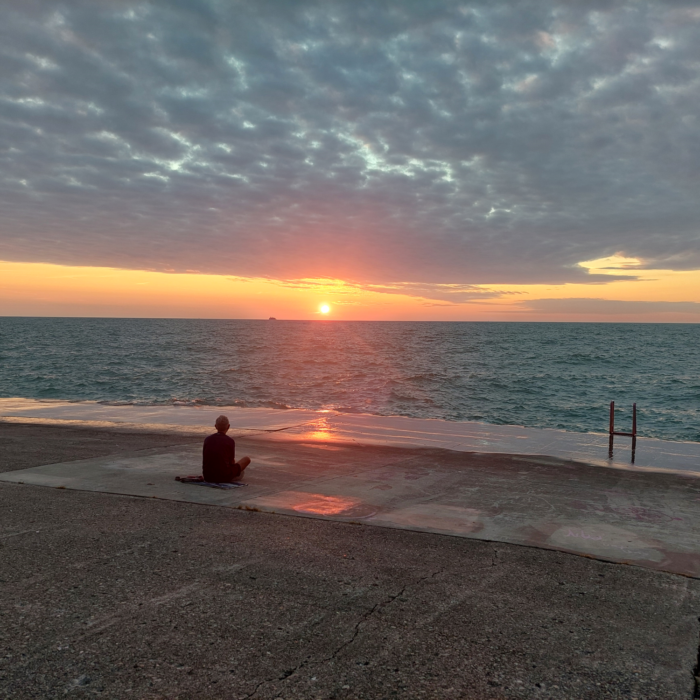
If you woke up after 7:30am, chances are quite good that you will see no sunshine today. As was the case this time last year, it is quite common to have very sunny skies at the crack of dawn only to have the clouds move in shortly thereafter. That’s one of the reasons I take pictures of the sunrises – because many of you sleepyheads just don’t believe me!

The lake had cooled down a bit from last week to a tepid 64F, but the swimming conditions were ideal. Chris, Carol, and I showed up for the sunrise, and Ann arrived later accompanied by new Lake Monster, Mollie. We all swam different routes and distances, and I ventured over to the “dark side” very briefly by swimming past the curve into the Ohio Street Beach swim area. I turned around just past Delaware Place making it a roughly 2-mile swim.

Everybody reconvened back at Ladder #1 after 30-45 minutes, and the whole Ochoa clan was out in force. We celebrated the 4th with some fresh pineapple doused with a bit of Barbancourt Estate Reserve – both of which are excellent post-swim treats.

Here are the pics:

Independence Day sunrise

july_4_2009_1

Patriotic kayaker

july_4_2009_2

Lake Monsters Carol (#24), Ann (#29), and Mollie (#30)

july_4_2009_3

Independence Day – July 4, 1776

FourthofJuly2009

SF Bay Swimming Primer

alcatraz

As more and more of you get comfortable swimming in Lake Michigan, I guarantee that you will be enticed by some of the more exotic swim events in San Francisco Bay. And you should definitely consider signing up for one (or more!) of them because they are hands down some of the coolest swim events you can do.

I field a lot of questions about swimming in SF Bay, and I’m always surprised at the level of misinformation surrounding these events. Most people seem to harbor two beliefs – namely, that SF Bay is dangerously cold and that it is infested by man-eating sharks. Both of these are false.

Regarding the latter, here’s a blurb from the Federal Bureau of Prisons site on the history of Alcatraz:

One of the many myths about Alcatraz is that it was impossible to survive a swim from the island to the mainland because of sharks. In fact, there are no “man-eating” sharks in San Francisco Bay, only small bottom-feeding sharks. The main obstacles were the cold temperature (averaging 50-55 degrees Fahrenheit), the strong currents, and the distance to shore (at least 1-1/4 miles). Prior to the Federal institution opening in 1934, a teenage girl swam to the island to prove it was possible. Fitness guru Jack LaLanne once swam to the island pulling a rowboat, and several years ago, two 10-year-old children also made the swim.

Regarding the former, yes the water in SF Bay is colder than an 80F swimming pool. But compared to Lake Michigan, it is relatively balmy for most of the year. While the SF Bay temperature rarely hits the 60F mark during the summer, the water doesn’t freeze over like it does here. Most of the time the SF Bay water temperature hovers in the 52F – 55F range, which we typically swim in on either end of the summer months (and during the winter, we swim in MUCH lower temperatures).

Just to give you an idea of what it’s like, here’s a write up for the Escape From the Rock Triathlon on what to expect during the swim:

If you find that when you jump in the water or start to swim that your heart begins to beat rapidly and your breathing feels out of control, this is perfectly normal. It’s just the adrenaline rush of race day paired with the shock of the cold bay water. Use your own judgment on whether to continue, especially if you have any medical conditions, but most people find that if they continue to swim, they warm up, get their breathing back under control and are able to get back into a groove and finish the swim. You may backstroke, or swim with your head out of the water until you’re comfortable to swim again.

Bottom line: with the proper equipment and preparation (all of which we blog about here) you can easily add a SF Bay swim to your list of endurance sports accomplishments.

The ultimate fact is that thousands of people do a Bay swim each year – and for many of these swimmers it’s their first open water experience ever. And if you still think this is something beyond your ability, let me remind you that a dog did the Alcatraz swim back in 2005 in just under 42 minutes.

jake2005

Men’s Health Month Wrap Up: Fitness Role Models

If you are brave enough to read or watch the news, you’ll notice two things:

1) Most of it is negative.
2) Most of it focuses on condoning or even glorifying the behavior of “celebrities” who often make very poor choices with regards to their health, their relationships, and their lifestyles.

We’re going to take a different approach with this post. As we close out the month of June, we’re going to commemorate Men’s Health Month by highlighting a few key individuals who – by their choices and actions – have raised the bar for the rest of us when it comes to fitness and health.

Mark Sisson (age 55)

Former competitive runner and triathlete, Mark Sisson has made a career out of unlocking the secrets of achieving good health in a safe and natural way. His website, Mark’s Daily Apple, is one of the best online resources of key information on health, wellness, anti-aging, safe weight-loss, nutrition, and supplementation. Mark’s health philosophy is based on an understanding of evolutionary science, and he provides readers and site visitors with invaluable insight and information on how to optimize overall human health.

Be sure to check out: The Primal Blueprint

Mack Newton (age 62)

8th degree black belt and a former Head Coach of the USA Taekwon-Do Team (1981-84), Mack Newton is a case study in achievement and fitness as well as in managing adversity. Two hip replacements from Vietnam-related injuries haven’t kept him from teaching and competing in Taekwon-Do – nor have they kept Mack from becoming one of the most sought-after fitness and conditioning specialists among professional athletes worldwide. In addition to his successful Taekwon-Do and fitness ventures, Mack is a celebrated author and motivational speaker who hosts “The Mack Newton Power Hour,” a weekly radio show on fitness and peak performance.

Be sure to check out: The 3-2 Eating Plan and A Path To Power: A Master’s Guide to Conquering Crisis

Arthur DeVany (age 71)

Scientist, athlete, and recognized expert on evolutionary fitness, Art DeVany personifies peak human health and conditioning. DeVany has consolidated a lifetime of science-based exercise and nutrition wisdom into his weblog which is well worth the subscription rate. DeVany expertly debunks the fitness fads and junk science still being touted today, and he outlines the key diet and exercise patterns that maximize human health.

Be sure to check out: Arthur DeVany Evolutionary Fitness Seminar

Jack LaLanne (age 94)

The “godfather of fitness,” Jack LaLanne continues to defy the aging process and is still going strong well into his ninth decade. Jack’s daily workout consists of strength training and swimming, and he follows the food mantra “If man made it, don’t eat it.” Nostalgia seekers who download and view old episodes from “The Jack LaLanne Show” are often astonished to realize that Jack was spot on about proper diet and exercise back in the 1950’s. And while there are some in the fitness world who still insist on other methodologies, it’s awfully hard to argue with Jack’s results!

Be sure to check out: Any of Jack’s Shows on YouTube

How to Keep Your Stuff Safe When Swimming

When I first started going out to the lake to swim, I was always paranoid about what to do with my valuables. In fact, I would have recurring nightmares where I would visualize packs of Chicago hoodlums gleefully rifling through my possessions while I watched helplessly from 1/4 mile off shore.

These days, I’m less concerned about this since I’ve developed a system for managing this risk. Here’s what I do:

1) I only bring out items that I need – most of which I will be wearing anyway (i.e. wetsuit, goggles, swim cap).

This means that I leave many items such as my wallet, cell phone, and extra keys at home. I’ll lock up my bike and take the bike lock key with me in a zip lock bag. However, I don’t leave a bunch of stuff out in the open for strangers to peruse. If someone wants to pilfer my ratty old swim towel, I figure they must really be desperate – so I view it as an act of charity on my part.

2) If I have to bring out valuables, I make it as difficult as possible to purloin them.

If I decide to bring out a cell phone or house keys, I’ll stash them in one of the other swimmer’s vehicles or I’ll find a way to secure them on site. One of my favorite gadgets for this is a PacSafe travel pouch used by backpackers and travelers. It’s “slash proof,” and you can lock it up to your bike or to a fixed object.

3) I always try to swim in an organized group setting so there are people around to keep watch.

This is one of the side benefits to running and organizing a swim group. Having more people out at the swim site raises the overall level of monitoring and supervision. Not only does this keep you safer in the water, but it also ensures that more people will be watching over everyone’s stuff.

Paleo Nutrition on the Cheap

PaNu, a new blog on paleo nutrition, has a great post on how to keep to a primal eating regimen without breaking the bank. Since it’s so concise, I’ve copied it here in its entirety:

1) Never eat anything that comes in a box (pasta, cereal, crackers…) Stick to the peripheral aisles at the grocery store.

2) Drink only whole milk, water or iced tea – you will get good nutrition from the milk, and water and homemade iced tea are dirt cheap or free. People spend a fortune on liquid food that is just High Fructose Corn Syrup and water. I drink only water at restaurants – I spend my money on the food instead.

3) Eat salads and veggies that you like.

4) Eggs are the perfect food and cheap protein- they contain amino acids in the exact ratio as found in your body (of course they do, they are meant to grow a bird fetus from scratch!) I eat 4-6 eggs a day at a cost of no more than a dollar a day.

4) If you can’t afford high quality grass-fed beef or bison, buy shoulder cuts and pork butts and smoke them or slow cook them. Take some fish oil to balance the high Omega 6’s with Omega 3’s.

5) Buy whole chickens and grill them – be sure to eat the skin, that’s the best part. Or go to Sam’s club for the 3 lb already roasted chicken – feeds a family of four for $5.

6) Drink half and half or whole cream for breakfast or add it to your coffee. Cheap, healthy (low insulin response) and fills you up.

While I would go easier on the diary products, these are pretty solid recommendations.