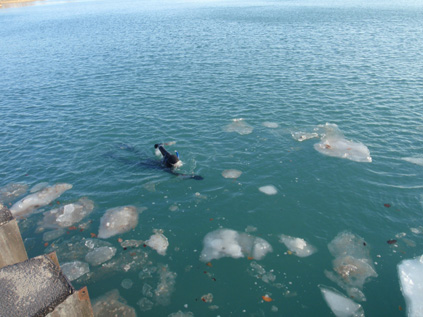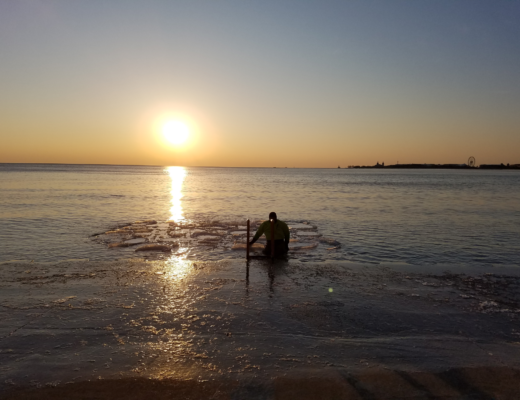
NOTE – I first published this piece last year in early June, and it turned out to be one of the more helpful pieces for swimmers and triathletes who were just starting to train in the lake. I’d recommend you review this again since it provides some great insight into what actually happens when you exert yourself in colder water conditions.
______________________________________________
In early 2008, the editors over at The Science of Sport did a fantastic two article series on Exercise in the Cold. I’m going to focus on the second part of the series since it talks about swimming. But the information is relevant to anyone who exercises in the elements.
Hyperventilation
First, what I really like about the piece is that it addresses the “cold shock response.” This is the physiological phenomenon that a swimmer or triathlete experiences when he or she suddenly plunges into cold water without properly preparing the body for this radical change of state. Per the authors:
One of the first things you experience when submerging yourself in cold water is something called the “cold-shock response.” This is characterized by an uncontrollable gasp for air, followed by a prolonged period of hyperventilation – more rapid breathing… the hyperventilation that happens in the cold has a profound effect on the ability to swim in an efficient manner [ed. - emphasis mine].
This is a key takeaway. Why? Because once the cold shock response is triggered – and the athlete’s respiration rate is elevated – it stays elevated for several minutes.
As evidence of this, the authors cite a 2005 study which measured how a swimmer’s respiration rate changed because of exposure to cold water. Here is a graph of the study results along with commentary from The Science of Sport:
So the rate of breathing goes up from about 16 breaths per minute to 75 breaths per minute, within the first 20 seconds. It then stays up at 40 breaths per minute for the next few minutes. It is not difficult to see how that would affect your ability to swim, because your stroke rate would have to change substantially to allow you just to breathe!
Tachycardia
In addition to hyperventilation, sudden cold water exposure can also trigger a rapid, or even irregular, heart rate:
The other big ‘killer’ is a heart attack, which can result when the temperature of the blood returning to the heart is suddenly cooled – this can affect the electrical conduction within the heart, causing fibrillation. So it is these two possibilities – drowning and cardiac arrest that are most likely the cause of death.
Granted, such incidents are quite rare during endurance sports events, but they do occur.
Last year, I posted a piece on this site about some triathlon fatalities that took place during the swim. While there were certainly some strong opinions about whether or not event organizers could have done anything to have prevented these fatalities, I strongly feel that it’s most likely an issue of training – or lack thereof.
Bottom line, the endurance sports community does a great job at teaching people swim techniques and drills. But in my experience, it does an inadequate job of instructing people on critical items such as how to manage your respiration and heart rate during heavy exertion in cold water.
Here are a few rhetorical question to athletes of all training levels looking to improve event performance:
What if you could minimize – or even prevent – this cold shock response?
How would a lower respiration rate at the front end translate to more endurance and energy during the bike and run portions?
What would this do to your overall confidence level going into the event?
Remember, there’s an old saying that “triathlons are all about the run.”
Water enters the lungs of a person triggering automatic spasms to the larynx
These spasms temporarily seal the air pipe in order to prevent additional liquid from entering the lungs (a natural defense mechanism)
This “choking” sensation triggers a panic response which accelerates the person’s heart rate
An accelerated heart rate coupled with a sealed air pipe causes generalized hypoxia, an inadequate supply of oxygen to the body as a whole
Deprived of oxygen, the person’s cells shift to anaerobic metabolism and flood the muscles with lactic acid, causing rapid fatigue which quickly leads to exhaustion
Unable to remain afloat, the person inhales additional water which accelerates the above cycle
The continuing oxygen deprivation leads to cerebral hypoxia causing unconsciousness
As the person loses consciousness, the larynx relaxes allowing the lungs to fill with water
Unless rescued at this point, the person dies from either advanced cerebral hypoxia or myocardial infarction (heart attack)
Not drowning is also just as easy.
The key is to interrupt this lethal cascade of events as early as possible – and one of the best ways to do this is to become comfortable with the technique known as drownproofing.
One of my biggest beefs with the endurance sports community is that they never seem to teach this as part of their open water swim training (as least I’ve never seen it being taught anywhere). Instead, they teach you how to tread water, swim faster, sight in open water, and navigate the chaotic scrum of the swim start.
But never how not to drown in the first place.
Whenever I work one-on-one with a swimmer for an open water lesson, the first thing we go over is drownproofing. I make sure they’re comfortable handling any situation that might potentially trigger the drowning process.
And drownproofing is really easy to learn – even a small child can do it:
So the next time you’re out in the open water with your swimming or triathlon training group, be sure to ask everyone whether or not they know how to drownproof.
And if the coaches don’t teach it – or if they don’t know what you’re talking about – you have my permission to nail them on it…
Yet another in the “how-did-I-ever-overlook-this-previously” category. Here’s a great video by Leslie Thomas from Swim Arton how to swim in choppier water conditions. Check it out!
This is a guest post from Nuala Moore, a veteran open water swimmer and event organizer who hails from SW Ireland. In addition to many other swimming feats, Nuala was part of a relay team that swam around Ireland (830 miles – no wetsuits) over 56 days. She’ll also be making a local appearance next month during her 6th Chicago Triathlon. Welcome Nuala!
——————————-
My name is Nuala Moore, and I am an open water swimmer living in the SW of Ireland. We are surrounded by amazing beaches, and the water flowing through our islands is the fastest and the freshest in spirit that you can swim in.
The water temperatures vary from early 40′s to 60′s (Fahrenheit). A huge variable is the air temperature. We rarely get above 70 so that means that the air is whipping the heat from our bodies quickly.
I am a super fan of deep water swimming and love the jaunt away from the shore. One of the biggest challenges that swimmers face here is that of the power of the water. Sometimes you wish to swim one way but it may not be possible. So we time our swims with the tide.
Anxiety and stress can often be the main reason that swimmers don’t finish. I try to work with that. We really have to learn to trust the boat crews. Their job is soley to mind us, and actually handing that trust can be a huge issue.
This weekend we have a 6km swim and a 3km swim in a beautiful bay of Ballydavid. It is called The Massacre after the 1580 battle in Smerwick harbour. We swim to the base of the monument. -Dramatic name!!
(click for larger image)
We also have a regatta to contend with, so it’s limited to 30 swimmers. Due to the tidal flow and emptying of the bay, we swim in a direction south of our destination; and the tide leaving the bay will usually bring us to where we need to go. The tide should be turning to get us home the other 3km.
You could end up swimming 2km longer just by getting this line wrong. How bays empty and fill is so important to know and to study for safety reasons. Also, it’s essential to have swimmers who can adjust their plans as well and not get stressed when they see themselves heading somewhere else.
(click for larger image)
Challenges differ in all waters, but overall I love the open ocean. It is so rewarding seeing swimmers battle and get there. I am a fan of getting swimmers to regroup and swim in a pod. It is very responsible and gives the surge of confidence and energy to drive on. We always have BBQ and a hot chocolate afterwards – super to share the experiences.
I also host swims of 2km/3km and 5km. I think once you’re wet and you have no plans for the afternoon, we may as well forge away.
Swimming is such a liberation of mind and soul. All the voices in your head are quelled by your own bubbles.
Here’s hoping for a super Massacre and the hope that Mother Nature looks kindly on us! All my swims are charity based, and we are all winners.
As much as I enjoy swimming outdoors, I have to admit that it’s not always a pleasant experience. Unlike a swimming pool (well, unlike MOST swimming pools at least), the lake is not a sterile and antiseptic environment.
So at any given time, you might find some or all of these niceties in the water:
- Algae
- Pollen
- Bacteria (especially E. Coli)
- Viruses
- Parasites
- Fungi
- Mold spores
- Sewage effluent
- Heavy metals
- Pesticides
- Runoff from agriculture and urbanization
- Air pollution particulates
These water contaminants – whether naturally occurring or artificially created – unfortunately wreak havoc on our bodies if they’re allowed to remain in our systems for extended periods of time. When left unchecked, they can cause allergies, mild to severe ear infections (i.e. swimmer’s ear), sinus infections, and flu-like illnesses due to water-borne contaminants.
So while many of us do what we can to keep our beaches and swim areas clean and contaminant-free, we have to accept the reality that it’s impossible to completely eliminate these health risks whenever we swim in the lake.
But what we can do is mitigate their impact on our personal health.
Here are a few tips and techniques I use to stave off the effects of swimming in any outdoor body of water where any of the above contaminants might be present:
Pre-swim
Prior to entering the lake, I irrigate my ear canals with a solution containing 50% white vinegar and 50% isopropyl alcohol:
Post-swim
As soon as I get out of the water, I once again irrigate my ear canals with the vinegar/alcohol solution. When I return home, I immediately get in the shower and clean myself with an antibacterial soap. I also irrigate my nasal passages with a warm water solution containing 1/4 teaspoon of sodium chloride (salt) and 1/4 teaspoon of sodium bicarbonate (baking soda):
To administer the vinegar/alcohol solution, I use a small pump spray bottle. For the nasal irrigation, I use a neti pot:
I used to get swimmer’s ear and have sinus problems all the time post-swim. However, I’ve never had any problems since I started with this pre/post swim “maintenance” program. So feel free to try this out if you think it can help you!
Check out this video of Terry Laughlin demonstrating the TI freestyle stroke:
The key thing to note is that he “spears” the water ahead of him and sustains this position for a few more moments while relaxing his hand. Also notice that he’s not really using his legs that much at all.
A lot of his forward momentum is actually coming from him driving his hips down. In other words, there’s very little emphasis on “grabbing and pulling” the water – which flies directly in the face of most swim instruction these days.
I recently adjusted my swim stroke accordingly, and I’ve noticed about a substantial improvement in being able to go faster and longer while using much less energy. Try it out!
Be sure to check out this excellent series of video clips featuring Terry Laughlin’s presentation at the 2009 New England Multisport Expo at MIT. It’s really great stuff!
Here’s a neat trick that we learned last year. Dave got a tip at a dive shop about how some divers use baby shampoo to keep their masks from fogging up. So we did some experimenting, and here’s my solution.
First, all you need are 1) baby shampoo, 2) tap water, and 3) a mini spray bottle that you can get at most drug stores:
What I do first is remove the spray nozzle unit and dip the plastic stem into the baby shampoo so it gets a very light coating:
I then fill the spray bottle about 7/8 full of tap water, leaving a bit of room at the top:
Finally, I place the shampoo-coated stem into the water-filled bottle and screw on the cap:
Whenever I need an instant defogging solution, all I have to do is shake up the bottle and apply a few sprays to each lens:
I keep the mixture dilute enough so I don’t have to rinse out my goggles or mask before putting them on. But feel free to do so if you just want a very light coating of the mixture.
The great thing about using baby shampoo is that it works unbelievably well as a defogger. Also, it’s specifically designed not to irritate your eyes (i.e. “no more tears’).
So give it a shot the next time you suit up. You’ll be pleasantly surprised at how much more effective it is than the much pricier defoggers at the sports stores. And the nice aroma also makes for a much more blissful swim experience!
In the “I don’t know how I missed this earlier” category, here’s a great video from Leslie Thomas at Swim Art on how to properly sight in the open water:
Dave and I had spoke earlier in the day, and he reported lake temperatures of 68F (69F at Ohio Street Beach). Shortly after that, some pretty vigorous thunderstorms arrived and stayed with us into the early evening. The rains subsided a bit after 7:00pm, so I decided to do a run out to Ladder #1 and get in a quick swim.
The water temperature was quite pleasant at Ladder #1 in just my swim trunks. No immersion shock or thermoclines, so the heavy rains and winds had not affected the 68F mark one bit. But the water still had a 12-inch chop along with some rolling swells. This combination provided a “perfect storm” for vertigo – which began to settle in once I started swimming.
I stayed close to Ladder #1 and opted to do back-and-forth laps parallel to the wall. But I was surprised at how quickly the vertigo would set in once I slowed down or stopped completely. I tried focusing on the water rhythms, and that helped a little bit. But the only thing that really shook off the vertigo was just powering through the chops in short but intense bursts.
The key here is that when the lake gives you “washing machine” conditions, you’re not fighting a current per se. This makes it difficult to gauge the rhythms and patterns of the water movements – and the result can be dizziness or vertigo. So if you find yourself in these conditions, don’t go for a long aerobic swim. Instead, make it a short swim with higher intensity “sprints” in the water. And stay close to the edge or the shore so you can “bail out” if you start feeling too overwhelmed.